
California Freeway Merges: How to Prove Fault When the Other Driver Blames You
Home » California Freeway Merges: How to Prove Fault When the Other Driver Blames You
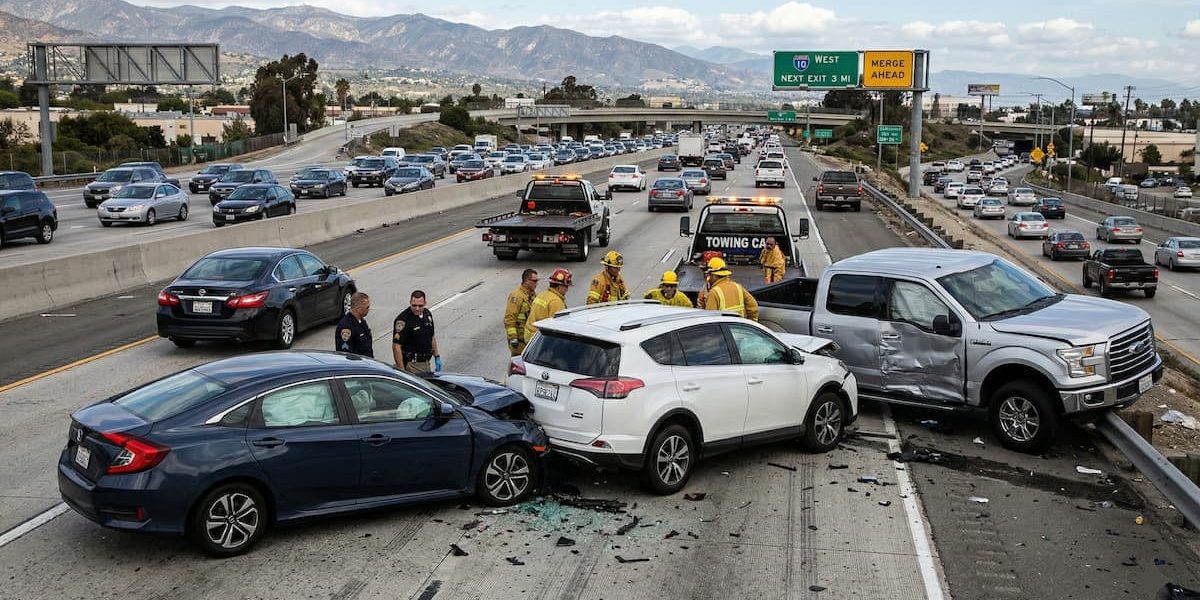
Merging onto a California freeway is one of the most statistically dangerous maneuvers a driver performs. You are attempting to fit a moving object into a narrow gap between other moving objects, all while traveling at 65 miles per hour or more. When a collision occurs during this delicate dance, the immediate assumption by police, insurance adjusters, and the other driver is that the person merging is at fault.
This default assumption is a problem. It relies on a simplified view of the law that ignores the difficult reality of modern traffic on major arteries like I-5, the 405, or US-101. Liability in merging accidents is rarely 100% on one driver, even if the traffic collision report says otherwise.
Proving fault in these cases requires establishing who actually had the right of way at the specific micro-second of impact and determining if the other driver had a Last Clear Chance to avoid hitting you. Without objective data, such as damage pattern analysis or black box downloads, insurance adjusters will almost always default to denying your claim or splitting liability to save money.
If you are dealing with a disputed merging accident and the insurance company is refusing to accept liability, call Aghnami Law Firm, your trusted Orange County car accident lawyer. We will review the collision report and damage photos to determine if the evidence supports a stronger claim than the insurance company suggests.
Key Takeaways for California Freeway Merging Accidents
- The merging driver is not automatically at fault. California law includes a Last Clear Chance doctrine and requires drivers already on the freeway to yield once a merge is safely initiated.
- Physical evidence is more persuasive than witness statements. Data from a vehicle’s black box (EDR) and analysis of the impact location can prove what really happened, overriding incorrect police reports or driver assumptions.
- You can recover damages even if you are partially at fault. California’s pure comparative negligence rule allows you to claim compensation, with the final amount reduced by your percentage of fault.
Who Actually Has the Right of Way on California Freeways?
Most drivers operate under a simple, usually incorrect, heuristic: the car entering the freeway must yield to the car already on the freeway.
While this is the baseline rule, it is not absolute. This misconception prevents many injured drivers from pursuing valid compensation claims because they assume they have no legal standing.
To understand your case, you must look at the actual laws governing these interactions.
The Duty to Yield is Not a Blank Check
Under California Vehicle Code 21804, a driver entering a highway is required to yield the right-of-way to all traffic passing on the highway that is “so close as to constitute an immediate hazard.”
However, the statute includes a second component. Once the entering driver has yielded and proceeds to enter, the drivers already on the highway “shall yield the right-of-way to the vehicle so entering.”
This means the right of way shifts. It is not a permanent shield for the driver in the number four lane. Once you have established your position in the lane safely, the duty of care transfers to the driver behind you to maintain a safe distance.
The Requirement to Stay Within a Lane
Simultaneously, California Vehicle Code 21658(a) mandates that a vehicle shall be driven “as nearly as practical” entirely within a single lane and shall not be moved from the lane until the driver has determined that such movement can be made with reasonable safety.
Defense attorneys frequently use this statute to argue that the mere existence of a collision proves the movement was not made with “reasonable safety.” We argue the opposite. Reasonable safety does not mean “guaranteed absence of an accident.” It means you acted as a prudent driver would. If another driver acts unreasonably, such as by speeding up to close a gap, your safe maneuver becomes unsafe through no fault of your own.
The Reality of the Zipper Merge
In high-density traffic, such as during rush hour in Los Angeles or the Bay Area, the strict yield rules practically dissolve. When traffic is crawling, the expectation changes to an alternating feed, commonly known as the zipper merge.
While not explicitly codified as a rule forcing drivers to alternate, the concept of Reasonable Care governs here. If a mainline driver refuses to allow a merging vehicle in during bumper-to-bumper traffic, causing a scrape or collision, a jury may find that the mainline driver was the one acting negligently. They failed to adapt to the traffic conditions, holding onto a technical right of way that resulted in a preventable crash.
If the other driver was speeding significantly (15+ mph over the flow of traffic) or was distracted, they may hold the majority of the fault, regardless of who was merging.
The He-Said-She-Said Trap: Why Physical Evidence Matters
In the moments following a crash on a busy freeway, adrenaline spikes. Memories blur. Witness statements are frequently unreliable because other drivers are focused on the road, not on your specific lane change. In a he-said-she-said scenario, the merging driver loses nine times out of ten. The presumption of fault is simply too high a barrier to overcome with words alone.
To win these cases, we move beyond verbal arguments and look at the physics of the crash.
Analyzing Impact Location
The specific point where the vehicles made contact is the strongest indicator of who possessed the lane.
- Rear Bumper vs. Front Bumper: If the damage is squarely on your rear bumper, it suggests you had already completed the merge and established possession of the lane. At that point, the accident becomes a rear-end collision, and the fault usually shifts entirely to the other driver for following too closely.
- Side Swipe/Quarter Panel: Damage to the side panels or front quarter panels indicates a dispute over the lane. This is the classic merging accident. Here, the depth and angle of the dents matter.
Scrape Patterns vs. Dents
Forensic analysis of the damage can reveal the vectors of force.
If the damage on your car is a deep dent, it implies the other vehicle drove into you. This happens when a driver on the mainline drifts into the merging lane or accelerates into the side of a merging car.
Conversely, long, horizontal scrape patterns (longitudinal scrapes) indicate that the vehicles were moving side-by-side with a speed differential. If the scrapes on your car start faint at the front and get deeper toward the back, it might indicate the other driver was accelerating past you while making contact. We work with accident reconstruction professionals to decode these markings.
The Black Box (Event Data Recorder)
Most modern vehicles are equipped with an Event Data Recorder (EDR). This device records telemetry data for the 5 seconds leading up to a collision.
This is the definitive truth-teller in a merging case. The EDR reveals:
- Speed changes: Did the mainline driver accelerate when they saw your blinker? If the data shows a spike in throttle percentage (gas pedal) right before impact, we argue they intentionally blocked you.
- Braking (or lack thereof): Did the other driver touch the brakes? A total lack of braking indicates distraction. If they were looking at the road, they would have reacted.
- Steering input: Did they try to swerve?
We send preservation letters immediately to prevent this data from being erased or the vehicle from being scrapped. If the insurance company destroys this evidence after being put on notice, we can ask the court to sanction them for spoliation of evidence.
Breaking Down the Three Most Common Merge Scenarios
Merging accidents tend to follow specific patterns.
Scenario 1: The Block-Out (Mainline Driver Speeds Up)
You check your mirror. You see a safe gap. You turn on your signal and begin to drift left. Suddenly, the driver in that lane slams on the gas to close the gap, hitting your side.
In this scenario, the other driver typically claims you cut them off. However, their sudden acceleration is an aggressive act that violates their duty of care. No driver is entitled to intentionally close a gap to prevent a merge if it risks a collision. By pulling the engine RPM and speed data from their EDR, we can prove they accelerated into the crash, shifting liability onto them.
Scenario 2: The Blind Spot Collision
This typically involves large commercial trucks or SUVs. You are merging, or you are already in the lane, and a larger vehicle moves into your space because they didn’t see you.
Commercial drivers have a higher duty of care due to the size and destructive potential of their vehicles. They are professionally trained to check blind spots and manage weave zones (areas where cars are entering and exiting simultaneously).
The defense will argue you were in their blind spot and therefore invisible. We counter with the concept of constructive notice: just because they didn’t see you physically, doesn’t mean you weren’t there to be seen. If you were visible for a sufficient time, their failure to look is negligence.
Scenario 3: The Forced Merge (End of Lane)
Your lane is ending. You have run out of pavement. You signal to get over, but the line of traffic next to you refuses to let you in.
In this situation, fault is usually shared. However, if traffic is stopped or moving slowly, the alternate feed custom (zipper merge) is the standard of reasonable care. If a driver refuses to follow this standard and forces a collision to defend their position in line, they are acting aggressively.
We look for video evidence or witness statements that confirm you were signaling for a sufficient duration and that the other driver had ample opportunity to let you in but chose not to.
How Comparative Negligence Affects Your Payout
California operates under a system called pure comparative negligence. This is good news for merging drivers. It means you can recover compensation even if you were partially at fault for the accident.
In many states, if you are 51% at fault, you get nothing. In California, you could be 90% at fault and still recover the remaining 10% of your damages. While that is an extreme example, it highlights that a finding of fault does not kill your case.
The Math of Fault
Under this rule, your final compensation is reduced by whatever percentage of fault is assigned to you. We investigate to find evidence, such as the other driver speeding, to demonstrate their responsibility for the collision. Our goal at Aghnami Law Firm is to use this evidence to drive your percentage of fault down as low as possible, maximizing the money that stays in your pocket.
The Last Clear Chance Doctrine
We utilize the legal doctrine of Last Clear Chance to reduce your liability. The law states that even if the plaintiff (you) was negligent, the defendant (them) is liable if:
- You were in a position of danger and could not escape.
- The defendant knew (or should have known) of your danger.
- The defendant had the last clear chance to avoid the accident but failed to use it.
If you merged poorly, but the other driver had three full seconds to brake and simply chose not to, the Last Clear Chance doctrine places the bulk of the blame on them.
The Role of Insurance Adjusters in Merging Claims
Adjusters use evaluation software that has inputs that automatically flag the merging vehicle as the liable party unless specific data points override that default setting.
There is also a natural bias. Adjusters hear “he cut me off” every day. They are conditioned to believe the person changing lanes is the one who disrupted the flow of traffic.
We do not rely on their investigation; we conduct our own. When we present independent forensic evidence, such as EDR data or high-resolution damage analysis, we force the adjuster (and their software) to deviate from the standard denial. We provide the justification they need to their supervisors to pay the claim.
FAQ for Freeway Merging Accidents
What if I was merging onto the freeway and the other driver was speeding?
Speeding significantly alters the liability equation. According to California law, a driver forfeits their right of way if they are driving at an unlawful speed. If we can prove their excessive speed via black box data or witness testimony, liability can shift away from you, as their speed prevented you from judging the gap correctly.
Can I still claim damages if I didn't use my turn signal?
It is more difficult, but not impossible. Failing to signal is a vehicle code violation, but it does not automatically make you 100% liable for the crash. If the other driver was distracted (texting) or intoxicated, their negligence was a greater cause of the accident than your failure to signal. Comparative negligence rules would apply here.
What if the accident happened in a construction zone with confusing lines?
If the lanes were poorly marked, or if the construction cones created a dangerous trap, the government entity (like Caltrans) or the construction company might share liability. This falls under dangerous condition of public property. These cases have strict filing deadlines (just six months), so you must act quickly to preserve your right to sue a government body.
The police report says I am at fault. Is my case over?
No. Police reports are generally considered hearsay in civil court when it comes to assigning fault. The officer was not there to see the accident; they are merely offering an opinion based on what they were told at the scene. We frequently overturn police report conclusions by presenting hard evidence that the officer did not have access to.
What if a commercial truck forced me off the road but didn't hit me?
This is called a no-contact accident, and yes, you can still recover damages. California law does not require physical contact between vehicles to establish liability. If another driver’s negligent behavior forced you to take evasive action (like swerving into a guardrail, running off the road, or hitting another vehicle), you have a valid claim against them.
Protect Your Claim After a Freeway Merging Accident
The assumption that the merging driver is always at fault is a convenient shortcut—convenient for insurance companies, not for you. California law is more nuanced than that simple rule suggests, and the physical evidence from your accident may tell a very different story than the one the adjuster may want to believe.
Call Aghnami Law Firm, your experienced Orange County personal injury lawyer. We will review your collision report, analyze the damage photos, and determine whether the evidence supports a stronger claim than you have been offered. If it does, we will pursue it.