
Los Angeles Rideshare Accident Attorneys
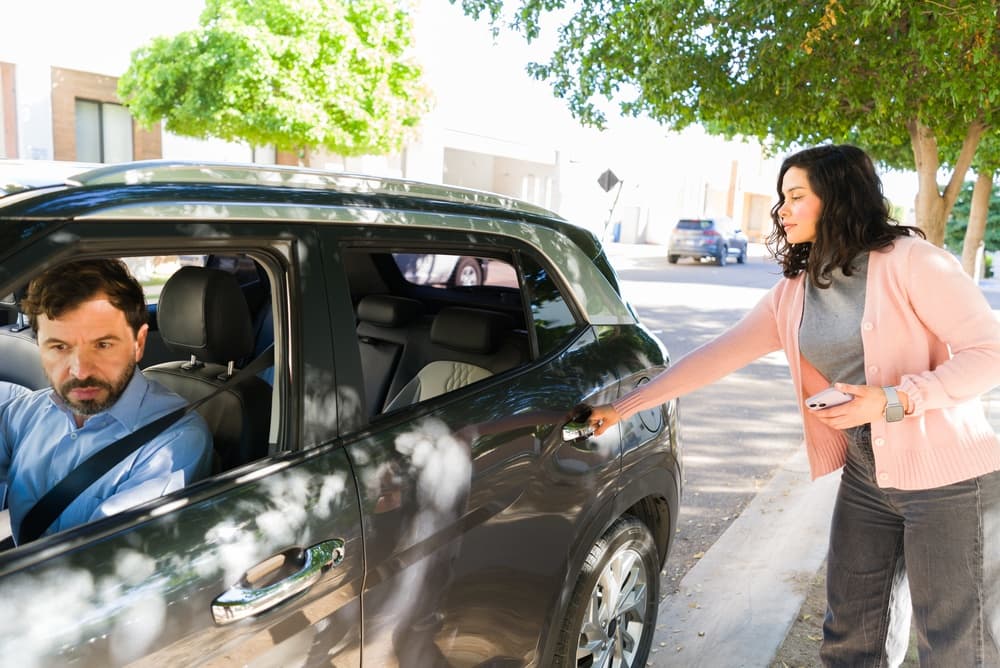
You got into an Uber or a Lyft and someone else’s driving put you in an emergency room. Aghnami Law Group handles Los Angeles rideshare injury claims, and a Los Angeles rideshare accident lawyer on our team can tell you which policy actually applies to your crash.
That question matters more now than it did a year ago. A change most Angelenos have never heard of took effect on January 1, 2026, and it cut the uninsured-driver safety net for injured rideshare passengers from $1 million to $60,000 per person.
Call Aghnami Law Group at (213) 212-4334 for a free consultation, and we will tell you which policy applies to your crash.
Table of Content
Who Is Liable in a Rideshare Crash?
Liability in a rideshare crash depends entirely on what the driver’s app was doing at the exact moment of impact, not just who caused the collision. Under California Public Utilities Code Section 5433, every Uber or Lyft trip is divided into distinct phases, and each phase carries a completely different insurance picture.
When the app is off, only the driver’s personal auto policy applies, which under California Vehicle Code Section 16056 now means at least $30,000 per person, $60,000 per accident, and $15,000 for property damage. Once the driver logs in and is waiting for a ride request, a contingent policy from the rideshare company applies, meaning it fills in only where the driver’s own insurance falls short, generally providing $50,000 per person, $100,000 per accident, and $30,000 for property damage, plus at least $200,000 in additional excess coverage that many people never learn about. Once a ride is accepted and the driver is en route to pick up a passenger, and for the entire trip afterward, the rideshare company’s commercial policy takes over with $1 million in liability coverage.
That last figure sounds reassuring, and for years it was. Which period a crash falls into is one of the most contested questions in these cases, since the difference between a $50,000 policy and a $1 million policy can completely change what a case is worth. A crash that happens 90 seconds before or after a driver accepts a ride request can land in an entirely different coverage tier, which means the exact timestamp of that acceptance often becomes the single most contested fact in the entire case.
The Coverage Cut Most Riders Do Not Know About
For about a decade, California required rideshare companies to carry $1 million in uninsured and underinsured motorist coverage for every passenger trip, protecting riders if the driver who hit them had no insurance or not enough. Senate Bill 371 cut that requirement to $60,000 per person and $300,000 per accident, effective January 1, 2026.
For a passenger with catastrophic injuries hit by an uninsured driver during an Uber or Lyft trip, that change can mean the difference between a settlement that covers the full cost of care and one that runs out early. Most riders have no idea this change happened, since it moved through the legislature with little public attention outside industry and legal circles. Our rideshare accident practice tracks exactly which coverage applies to a given crash date, since a crash that predates the change may still fall under the older, higher limits, depending on when the applicable policy was issued or renewed.
Lawmakers framed the change as a way to reduce costs for rideshare companies and reinvest savings into driver pay and rider affordability, and the state has committed to studying the real-world impact of the lower limits by decade’s end. In the meantime, injured passengers hit by uninsured or underinsured drivers have a much smaller safety net than they did a year ago, and most people find that out only after they need it.
Where Los Angeles Rideshare Crashes Happen Most
Los Angeles produces a specific mix of rideshare crash scenarios tied to its size, its nightlife, and its airport traffic.
- LAX pickup and dropoff crashes, where dense curbside congestion and confused first-time visitors create constant near-misses
- Freeway crashes on the 101, 405, and 10, particularly during late-night pickups when tired drivers are checking GPS directions on unfamiliar routes
- Double-parked pickup incidents, where a waiting rideshare vehicle gets rear-ended or forces a cyclist unexpectedly into moving traffic to go around it
- Pedestrian strikes near nightlife corridors, where a driver searching intently for a passenger’s exact location becomes distracted at the worst possible moment
- Distracted driving crashes tied directly to the app itself, since drivers are required to glance at turn-by-turn navigation directions and incoming trip requests while actively driving
- Crashes involving a driver logged into multiple competing rideshare apps at the exact same time, which complicates which company’s insurance actually applies
Each of these scenarios changes what evidence matters most, from app timestamp data to curbside camera footage from nearby businesses. A crash near LAX often comes with airport security footage covering the exact curb where the pickup was supposed to happen, while a late-night freeway crash might rely more heavily on the driver’s own trip history and navigation data.
What Compensation Can Cover?
Compensation in a Los Angeles rideshare accident case generally includes the same categories as other injury claims, filtered through whichever insurance policy actually applies to your specific crash.
- Medical expenses connected to the crash, both the bills already incurred and the documented cost of care still ahead
- Lost income and reduced future earning capacity if the injury affects your ability to work
- Property damage to your vehicle or personal belongings that were damaged in the crash
- Pain and suffering tied to the physical and emotional toll of the injury
- Wrongful death damages when a rideshare crash proves fatal
No two rideshare cases carry the same value, and a number quoted before anyone has confirmed which coverage period applies skips the single most important step in the process. These claims still follow California’s standard two-year statute of limitations, the deadline for filing suit, under California Code of Civil Procedure Section 335.1, though sorting out coverage disputes often takes longer than a simpler crash claim, making early legal involvement more valuable rather than less.

Why Period Disputes Decide These Cases
A period dispute is not a technicality. It is usually the whole case, because the coverage available can swing by more than $900,000 on a matter of seconds. A driver who was logged in and en route, but whose app briefly glitched or lagged in reporting status, can end up at the center of exactly that argument.
We pull app data, driver logs, and dispatch records early, while the records are still routine to produce rather than the subject of a motion. We also read a coverage position closely, since the first position in any negotiation is rarely the last one.
Call Aghnami Law Group at (213) 212-4334, and we will tell you which policies are likely in play.
How Does Our Rideshare Accident Practice Build Your Case?
We start with a free consultation identifying every policy that might apply, including the driver’s personal coverage, the rideshare company’s contingent or commercial policy, and your own uninsured motorist coverage under California Insurance Code Section 11580.2 if the numbers do not add up. From there, we move quickly to preserve app data and driver status records, since this evidence can be difficult to obtain once too much time passes.
If a rideshare company’s insurer will not offer a fair value, we prepare Los Angeles car accident cases as though they may go to trial, and we negotiate from that position. You work directly with an attorney throughout the process, and the attorney who knows your file is the one handling it.
We also communicate clearly about how coverage period disputes actually work, since clients often arrive assuming the full $1 million policy automatically applies simply because they were riding in an Uber or Lyft at the time. Setting realistic expectations early, based on the actual facts of the crash, tends to produce a smoother process than discovering a coverage surprise months into negotiations. We take these cases on a No Fee unless we win basis, and the first consultation is free.
What To Do After a Rideshare Crash in Los Angeles
The steps you take right after a rideshare crash protect both your health and your claim.
- Call 911, follow through on any care you are advised to get, and request a copy of the responding officer’s report
- Screenshot the trip details in the app immediately, including the driver’s name, vehicle information, and trip status
- Photograph the vehicles, the scene, and your visible injuries before conditions change
- Get contact information for any witnesses, especially at busy pickup zones where people disperse quickly
- Avoid accepting an early settlement offer from any insurer until you have spoken with a rideshare accident lawyer in Los Angeles, CA
Skipping any of these five key steps leaves more room to dispute which coverage period actually applies to your crash, and that dispute often becomes the entire battle in a rideshare case rather than a simple question of fault.
FAQs: Los Angeles Rideshare Accident Lawyer
What if I was a pedestrian hit by an Uber or Lyft driver, not a passenger?
The same period-based coverage framework applies to pedestrians and other drivers hit by a rideshare vehicle, not just passengers riding inside it. Proving the driver was logged into the app and actively working at the moment of impact often determines whether you have access to $50,000, $100,000, or the full $1 million commercial policy, which makes early evidence preservation just as critical for pedestrian claims as it is for passenger claims.
What if the rideshare driver says they were not logged into the app at the time?
This is one of the most commonly disputed facts in these cases, and a Los Angeles Uber accident lawyer should verify it independently rather than accepting the driver’s account. App companies maintain detailed login and trip status records that can be requested through legal channels, and those records often tell a different story than what a driver initially claims.
Can I sue Uber or Lyft directly, or only the driver?
In California, this is settled by statute rather than by company policy.Business and Professions Code Section 7451, enacted by Proposition 22 and upheld by the California Supreme Court in 2024, classifies app-based drivers as independent contractors, meaning they work for themselves rather than for the app, when four conditions about scheduling and flexibility are met. That is why most claims proceed against the applicable insurance policy rather than naming the company, and a Lyft accident attorney Los Angeles clients consult can help identify whether any exceptions apply, such as claims involving the company’s own negligence in vetting or supervising a driver.
What if I was injured during a shared ride with another passenger I did not know?
Your claim generally proceeds the same way regardless of whether other passengers were sharing the trip, since liability and coverage depend on the driver’s status and conduct rather than the ride type. Multiple injured passengers from the same crash typically each pursue their own individual claims, and one passenger’s settlement amount does not reduce what is available to another passenger injured in the same incident.
Does it matter if I flagged down a driver already nearby instead of requesting through the app?
Yes, potentially. Coverage under California’s rideshare framework generally depends on the driver being logged into the app and operating under its terms at the time, so an informal arrangement outside the platform could complicate which policies actually apply to your specific injury claim.
What if the crash happened while I was still waiting to be picked up, before I got in the car?
You may still have a claim, but the coverage available depends on whether the driver had already accepted your specific ride request at the time of the crash. This distinction between simply being logged in and having an accepted, active trip can significantly change which policy limit applies, sometimes moving a claim from the contingent $50,000 tier all the way up to the full $1 million commercial policy, depending on exactly when that acceptance registered.
Talk to a Los Angeles Rideshare Accident Lawyer Today
Coverage in a rideshare crash depends on details most people never think to check, and the safety net for uninsured-driver crashes is now a fraction of what it was. Call Aghnami Law Group at (213) 212-4334 for a free consultation, and a Los Angeles rideshare accident lawyer will identify every policy that applies to your case.

Aghnami Law Group - Los Angeles Office
1801 Century Pk E 24th Floor
Los Angeles, CA 90067
Ph: (213) 279-0976
Why Choose Us?
- Free Consultation: We offer free consultation to discuss your case and explore your options.
- No Upfront Fees: We work on a contingency basis, meaning you don’t pay unless we win your case.
- Proven Track Record: Our experienced attorneys have recovered millions of dollars for their clients.
- Transparent Communication: We keep you informed and involved, providing updates and answering your questions promptly.
- Client Centered Approach: We prioritize your needs and tailor our strategies to achieve the best poossible outcome for you.
Five Star Rated Service!
