
Who Pays When Loose Cargo Falls Off a Truck on the Freeway?
Home » Who Pays When Loose Cargo Falls Off a Truck on the Freeway?
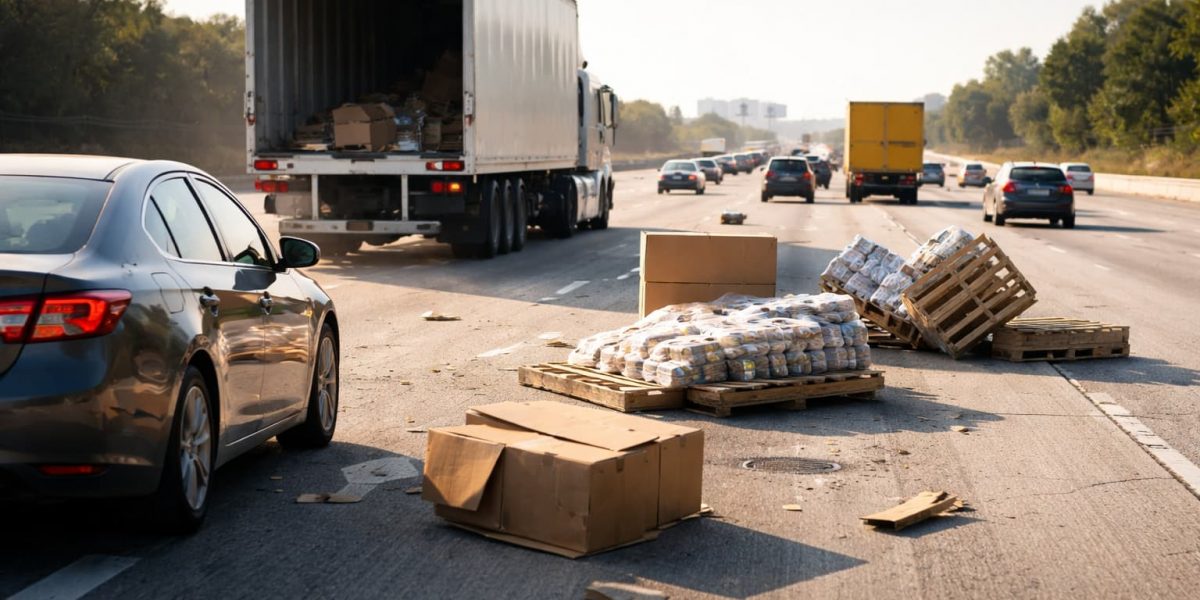
When cargo falls from a truck and strikes your vehicle, more than one party may be legally responsible for your losses. A road debris accident lawyer in California can help identify who is liable, because the answer is rarely limited to the driver alone.
The trucker may not have even realized that a box or pallet had left the trailer. What looks like random highway chaos often traces back to a specific decision made long before that truck merged onto the freeway.
These cases carry real stakes. Property damage, serious injuries, and insurance disputes can follow a debris strike, and the situation becomes more complicated when the truck is long gone before anyone thinks to document the cargo or the scene.
California freeways, like the SR-91 corridor, which handles heavy commercial traffic from the ports of Los Angeles and Long Beach, see these incidents with troubling regularity.
How liability works in a shifting load accident, and how investigators connect spilled cargo back to the party who packed it, is what gives injured drivers a clearer path forward.
The parties responsible, the insurance policies available, and the legal theories that apply all depend on facts that a skilled legal team can uncover.
Reach out to an Orange County truck accident lawyer today to identify who is liable and pursue compensation after a loose cargo crash.
What the Law Says
- The driver is rarely the only liable party: Warehouses, shippers, and third-party loaders may each share responsibility for cargo that was improperly packed before the truck ever left the dock.
- A separate insurance policy may apply: When negligent loading at a warehouse caused the debris, that warehouse carries its own commercial liability coverage entirely apart from the trucking company’s policy.
- Cargo can be traced even after the truck disappears: Freight manifests, cargo markings, electronic logging records, and freeway camera data can connect spilled debris to its source.
- California’s comparative fault rules allow claims against multiple defendants: More than one party can be held responsible in the same claim, and each is assigned a share of liability based on their role.
- Evidence disappears quickly: Loading logs, warehouse footage, and freight records have limited retention windows, making prompt legal action essential to building a strong claim.
Why Cargo Falls Off Trucks in the First Place
Not every piece of freight is secured the same way. Commercial carriers operate under federal regulations set by the Federal Motor Carrier Safety Administration, which require that cargo be immobilized or secured to prevent it from shifting during transit.
When those rules are ignored or rushed through, the results appear on the highway. Several distinct failures can send cargo into traffic:
- Improper tie-down equipment: Straps rated for lighter loads than the cargo being hauled may snap or stretch under highway speeds and sharp turns.
- Overloaded or unbalanced stacking: When heavier items are placed on top of lighter ones, or when weight is distributed unevenly, a hard brake or a curve can shift the entire load.
- Failure to check securement during the trip: Drivers are required to inspect their cargo within the first 50 miles and again at regular intervals under FMCSA rules. Skipping those checks means a loosening strap goes unnoticed.
- Negligent loading at the warehouse: Before the truck ever leaves the dock, someone decided how to arrange and secure that freight. If the initial load was packed carelessly, no amount of careful driving will prevent a problem.
Each of these failures points toward a different potential defendant, and that distinction matters enormously when building a shifting load accident liability claim.
The Mystery Defendant: Tracing Cargo Back to Its Source
Here is where road debris accident cases in California become genuinely complex, and where a road debris accident lawyer becomes critical to the outcome.
The truck driver is often the most visible party at the scene, but the driver may carry only the minimum required insurance. More importantly, the driver may not have loaded the cargo at all. In commercial freight, loading is frequently handled by a separate company: a warehouse, a freight broker’s contractor, a third-party logistics provider, or the shipper’s own dock workers.
How the Loading Chain Works
A single shipment might pass through several hands before it hits the freeway:
- The shipper packages the goods and arranges for pickup
- A warehouse or third-party loader stages, stacks, and secures the freight onto the trailer
- A trucking company assigns a driver to pick up the loaded trailer
- The driver takes possession and is responsible for verifying securement before departure
When cargo escapes that trailer at 70 miles per hour on the SR-91, the question is not just who was driving. It is who packed it, who signed off on it, and whether the equipment used to secure it met federal standards.
Why This Matters for Compensation
If liability rests entirely with the driver or the trucking company, the available insurance coverage may be limited. But if the warehouse or loader is found responsible for negligent loading, that entity carries its own commercial general liability policy, which is often a completely separate and substantial source of compensation.
Suing a warehouse for improper loading is a distinct legal claim from suing a trucking company for a driver error.
It requires evidence about how the cargo was packed, what securement methods were used, who oversaw the process, and whether that process met applicable standards. Gathering that evidence requires acting quickly before freight manifests, loading logs, and warehouse surveillance footage are no longer available.
California Law and Road Debris Liability
California follows a pure comparative fault system under California Civil Code Section 1714, meaning that each party’s share of fault is weighed separately. Multiple defendants can each be assigned a percentage of responsibility, and a plaintiff may still recover compensation even if they bear some portion of fault.
This structure benefits injured drivers in cargo debris cases because it allows claims against several parties simultaneously: the driver, the motor carrier, the loader, the shipper, and in some cases the cargo owner. Each defendant’s insurer may dispute responsibility and point to another party, which is exactly why having legal representation from the beginning of a road debris accident claim matters.
What California Requires of Commercial Drivers
The California Commercial Driver Handbook outlines that commercial drivers bear responsibility for inspecting and verifying cargo securement before moving. A driver who accepts a loaded trailer without checking the tie-downs may share responsibility for what spills from it, even if the initial loading failure happened at the warehouse.
That shared responsibility does not eliminate the loader’s liability. It simply means both parties may be named in the same claim.
SR-91 Cargo Accidents: A Specific Problem on a Specific Road
The SR-91 freeway connects Riverside and Orange Counties through some of the most congested freight corridors in the country. Trucks moving goods from the ports of Los Angeles and Long Beach frequently travel this route, and the combination of high speeds, dense traffic, and heavily loaded trailers creates conditions where improperly secured cargo causes serious crashes.
When a road debris accident happens on the SR-91, drivers often lose sight of the truck almost immediately. High-volume freeway traffic means witnesses scatter. The truck continues down the road. By the time law enforcement arrives, the source of the debris may be unknown.
Reconstructing a Road Debris Accident Without a Witness
Investigators and legal teams use several methods to trace debris back to its origin:
- Cargo markings, labels, and lot numbers on recovered debris
- Freight manifest records from the trucking company or broker
- Weigh station data and electronic logging device records
- Surveillance footage from Caltrans cameras or nearby commercial properties
- Witness accounts collected from other drivers at the scene
A road debris accident lawyer familiar with California commercial freight cases knows where to look and how to preserve that evidence before it becomes unavailable.
The Insurance Puzzle in Cargo Spill Cases
Most drivers assume that after a truck drops cargo on the freeway, the trucking company’s insurer handles everything. In practice, multiple insurance policies may apply, and each insurer has a financial incentive to argue the other should pay.
The motor carrier’s commercial auto policy typically covers accidents caused by the driver. A warehouse or third-party loader’s general liability policy covers property damage and injuries caused by their own negligent acts, including improper loading.
The shipper may carry cargo insurance that applies to the goods themselves but not necessarily to the damage those goods cause when they spill.
Why Multiple Policies Change the Outcome
Sorting through overlapping policies, exclusions, and coverage disputes is a significant part of pursuing a shifting load accident liability claim in California. Injured drivers who approach that process without legal support often accept settlements from one insurer without realizing another policy existed entirely.
Identifying every available policy requires understanding how commercial freight relationships are structured and which entity bears contractual responsibility for each phase of the loading and transport process. That investigation is where a road debris accident claim either recovers its full potential or falls short.
FAQ for Road Debris Accident Lawyer California
What if I never got the truck's license plate after the accident?
Plate information is helpful but not always necessary. Cargo debris often carries identifying information, and freeway camera networks, trucking dispatch records, and freight manifests can help trace the source of a spill even when the truck left the scene before anyone documented it.
Can I sue the warehouse if the truck driver was never cited?
Yes. A citation, or the absence of one, does not determine civil liability. The warehouse’s responsibility for improper loading is evaluated separately from whether the driver received a ticket at the scene.
How long do I have to file a claim after a road debris accident in California?
California’s statute of limitations for personal injury claims is generally two years from the date of the injury. Property damage claims follow a three-year limit. Waiting significantly reduces the chances of preserving the freight records and surveillance footage that support these cases.
Does it matter if the cargo hit my car directly or if I swerved and struck something else?
Both scenarios may support a claim. If an evasive maneuver was a reasonable response to sudden road debris and that maneuver caused a secondary collision, the party responsible for the debris may still bear liability for the resulting harm.
What if I was partially at fault for following too closely?
California’s comparative fault rules mean that your own degree of fault, if any, would reduce the compensation you might recover rather than eliminate it entirely. The full circumstances of the accident are evaluated to determine each party’s share of responsibility.
When the Debris Is Gone, the Case Is Not
Road debris disappears fast. Caltrans crews clear it. Other vehicles scatter it. The truck is already miles away. It can feel like the evidence evaporated along with the cargo that caused the accident.
But the paper trail behind commercial freight does not disappear as quickly. Loading logs, delivery manifests, electronic logging devices, and warehouse documentation all exist somewhere, and they tell the story of how that cargo was packed and by whom.
The legal theory that holds a loader or shipper responsible for what happened on the SR-91 does not require a witness who watched the box fall. It requires someone who knows how to read freight records and connect them to your injuries.
What would it mean for your recovery to discover that a separate insurance policy and a defendant you never knew existed might be part of your case?
Reach out to Aghnami Law Group to talk through what happened and explore every potential source of accountability.