
What if the Orange County Owner Claims I Provoked the Dog?
Home » What if the Orange County Owner Claims I Provoked the Dog?
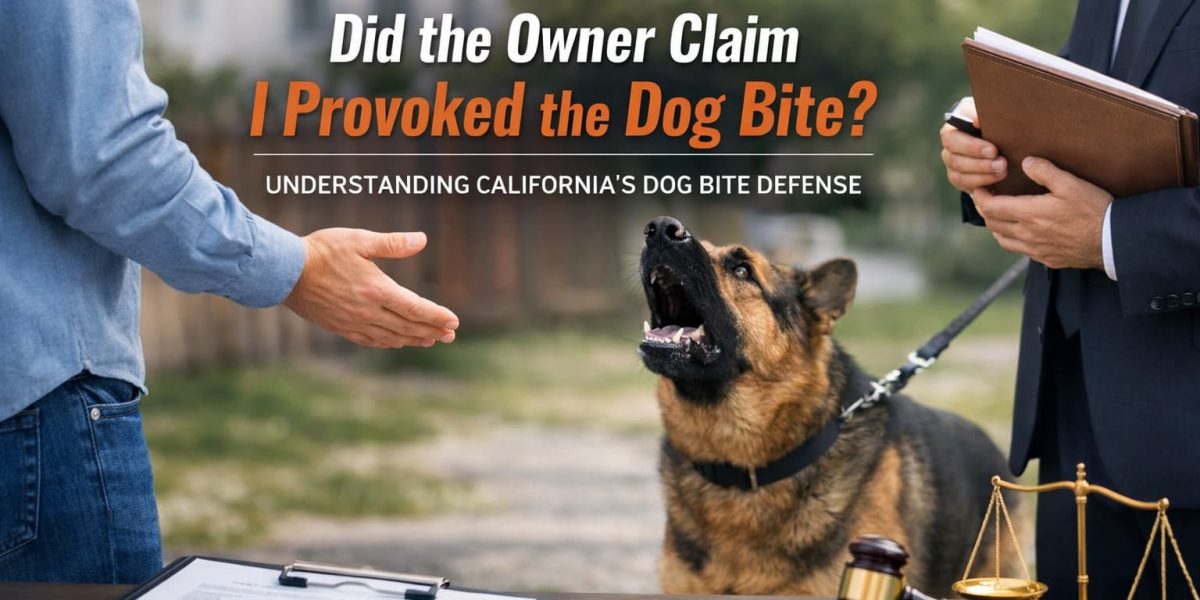
The dog bite provocation defense is the single most common argument dog owners raise after their animal injures someone, and it is far narrower than most people realize. California’s dog bite statute imposes strict liability on owners, meaning the owner is responsible for injuries their dog causes regardless of whether the animal had bitten anyone before.
Provocation is the primary legal escape from that liability, and what legally qualifies as provocation is a question with a specific answer, one that excludes most of the everyday interactions that dog owners routinely label as teasing or antagonizing.
Petting a dog is not provocation. Approaching a dog is not provocation. Making eye contact, moving suddenly, or startling an animal does not meet the legal definition of provocation under California law.
An owner who watches their dog bite a stranger and responds with a claim that the victim must have done something to deserve it is engaging in a victim-blaming narrative that collapses quickly under scrutiny, particularly when a canine behavioral expert examines whether the dog’s reaction was proportionate to anything the victim actually did.
In Orange County, where dogs are a fixture of residential neighborhoods, parks, and commercial spaces, dog bite claims are common, and the provocation defense is raised in a significant number of them. Knowing what it actually requires and how it is defeated is the foundation of any successful dog bite injury claim against an owner who refuses to accept responsibility.
Reach out to an Orange County dog bite lawyer today to challenge unfair provocation claims and protect your right to full compensation after a dog attack.
Dog Bite Provocation Defense
- California imposes strict liability on dog owners: Under California Civil Code Section 3342, a dog owner is liable for injuries their dog causes in a public place or lawfully accessed private property, regardless of the dog’s prior behavior or the owner’s knowledge of any aggression.
- Provocation is the owner’s burden to establish: The owner asserting provocation as a defense must prove it. The burden does not fall on the injured person to disprove it, and the standard for what constitutes legally sufficient provocation is high.
- Ordinary interaction with a dog does not constitute provocation: Reaching toward a dog, making noise near it, or touching it gently does not meet the legal threshold. Provocation requires intentional conduct that a reasonable person would recognize as likely to cause an aggressive response.
- Children are evaluated under a different standard: California courts apply a reasonable child standard when evaluating whether a minor’s conduct constituted provocation, recognizing that children interact with animals differently than adults and cannot be held to the same behavioral expectations.
- Canine behavioral experts can defeat disproportionate reaction claims: When a dog’s response to benign or minor conduct is extreme, a behavioral expert can establish that the animal’s aggression was disproportionate to any stimulus, which undermines the provocation defense at its core.
California’s Strict Liability Rule and Why Provocation Is the Only Real Defense
California Civil Code Section 3342 establishes that the owner of any dog is liable for damages suffered by any person who is bitten by the dog while in a public place or lawfully in a private place. The statute does not require proof that the owner knew the dog was dangerous. It does not require a prior bite history. Liability attaches to the fact of the bite and the ownership of the dog.
That strict liability framework leaves dog owners with very limited defenses. They cannot argue they had no reason to expect aggression. They cannot argue the dog had never bitten before.
The defenses that work in ordinary negligence cases, the “I had no idea” arguments, are not available under a strict liability statute. Provocation is the most significant affirmative defense remaining, which is exactly why owners reach for it so reflexively after an attack.
What an Affirmative Defense Actually Means
When a dog owner raises provocation as an affirmative defense, they are claiming that the victim’s own conduct caused the attack and that this conduct should relieve the owner of liability. As the party asserting that defense, the owner bears the burden of proving it.
The injured person does not walk into court needing to prove they did nothing wrong. The owner must establish that what the victim did legally qualifies as provocation under California law.
That burden allocation is significant. It means the victim’s claim begins from a position of strength, and the owner must produce evidence, not just an assertion, that the victim’s conduct meets the legal standard.
What Legally Qualifies as Provocation in California
California courts have defined provocation in dog bite cases as intentional conduct by the victim that a reasonable person would recognize as likely to provoke an aggressive response from a dog. The conduct must be intentional, not accidental. It must be conduct that reasonably predictable would cause aggression, not merely conduct the particular dog happened to dislike.
Accidentally stepping on a dog’s paw, reaching toward the animal in a friendly gesture, or making a sudden movement that startles the dog does not satisfy that standard.
Neither does running near a dog, making noise in its vicinity, or touching it without the owner’s permission. These are ordinary human behaviors that dogs encounter regularly, and California law does not treat an animal’s aggressive response to ordinary behavior as the victim’s legal fault.
What Courts Have Found Does Not Constitute Provocation
The scope of what fails to qualify as provocation is broader than many dog attack victims realize. Courts have consistently held that:
- Approaching or reaching toward a dog: Moving toward a dog or extending a hand, even without the owner’s explicit invitation, does not constitute provocation absent conduct specifically designed to threaten or harm the animal.
- Petting without the owner’s permission: Touching a dog without asking the owner first may be socially inadvisable, but it does not transform the owner’s liability into the victim’s fault.
- Loud voices or sudden movements near the dog: Dogs that react aggressively to normal human noise or movement display behavioral responses that reflect on the animal’s temperament, not the victim’s provocation.
- Accidental contact or startling the dog: An unintentional action, regardless of its effect on the dog, cannot constitute provocation because provocation requires intentional conduct.
Each of these scenarios represents a factual pattern where the provocation defense has been raised and defeated. The defense is most effective when the victim did something deliberate and specifically directed at the animal that went well beyond ordinary interaction.
Using Behavioral Experts to Defeat the Provocation Defense
When a dog owner argues provocation, they are making a claim about causation: that the victim’s conduct caused the dog’s aggressive response. Canine behavioral experts attack that claim from a different direction by examining whether the dog’s response was proportionate to any stimulus the victim provided, regardless of what that stimulus was.
What the Behavioral Expert Actually Evaluates
A canine behavioral expert retained in a dog bite case typically examines:
- The dog’s breed characteristics and behavioral baseline: Some breeds carry recognized behavioral traits that affect the aggression analysis, though breed alone does not determine individual temperament.
- The dog’s socialization and training history: A dog that was improperly socialized, trained with aversive methods, or kept in conditions that promote territorial aggression may respond to benign stimuli in ways that well-socialized animals would not.
- The proportionality of the response to the stimulus: Even assuming the victim did something that mildly annoyed or startled the dog, was a full attack a proportionate response? A behavioral expert who testifies that a normally temperamented dog would have backed away, growled, or moved off rather than attacking provides direct evidence that the dog’s response was the product of the animal’s own dangerous disposition.
- Prior behavioral indicators: Growling at visitors, lunging on the leash, resource guarding, or other aggression patterns that the owner may have observed and ignored prior to the attack are relevant to both the provocation analysis and the broader question of the owner’s awareness.
The behavioral expert’s testimony does not need to prove that the victim did nothing at all. It needs to establish that whatever the victim did was insufficient to justify the attack in a behaviorally sound animal, which shifts the focus back to the dog’s temperament and the owner’s responsibility for it.
FAQ for Dog Bite Provocation Defense
What if there were no witnesses to the dog bite and it is my word against the owner's?
The absence of direct witnesses does not leave the claim without evidence. Medical records documenting the nature and location of the bite wounds, photographs of the injuries, the dog’s veterinary history, and testimony from people familiar with the dog’s behavior all contribute to the evidentiary record. A behavioral expert who examines the circumstances and the dog’s history can offer opinions that carry significant weight even without an eyewitness account of the attack itself.
Can the owner use my prior interactions with the dog as evidence of provocation?
Prior positive interactions with a dog do not prevent a provocation defense, but they cut both ways. A victim who has interacted with the dog many times without incident and behaved the same way on the day of the attack undermines the owner’s claim that the conduct was provocative. Prior interactions are part of the factual record and may actually strengthen the victim’s position.
What if the owner claims their dog was protecting them from a perceived threat?
A dog acting defensively to protect its owner may still expose that owner to liability. The question returns to whether the victim’s conduct constituted legally sufficient provocation. A dog that attacks because a visitor moved toward its owner in an ordinary way reflects an animal whose protective response is disproportionate to the threat, and a behavioral expert can address that specifically.
Does it matter that the dog had never bitten anyone before?
Under California’s strict liability statute, prior bite history is irrelevant to the owner’s liability. The “one free bite” rule that applies in some other states has no place in California dog bite law. The absence of a prior bite history cannot be used to reduce the owner’s responsibility for the attack.
How long do I have to file a dog bite claim in California?
California’s statute of limitations for personal injury claims is generally two years from the date of the injury under California Code of Civil Procedure Section 335.1. Claims involving government employees or government-owned animals may carry shorter notice requirements. Acting promptly protects both the legal right to sue and the ability to gather evidence while it remains available.
Provocation Is a Defense, Not a Verdict
When a dog owner claims the victim provoked the attack, they are making a legal argument, not stating a fact. That argument has a specific definition, a specific burden of proof, and a specific set of factual requirements that most real-world interactions with dogs do not satisfy.
A behavioral expert who examines the attack in context, the dog’s history, and the proportionality of its response can turn that argument into evidence of the animal’s dangerous disposition rather than the victim’s fault.
California’s strict liability framework was designed to protect people injured by dogs, and the provocation defense was not designed to swallow that protection. It was designed to address genuine, intentional conduct directed at an animal that a reasonable person would recognize as dangerous.
Petting a dog, reaching toward it, or simply being near it does not meet that standard, regardless of how insistently the owner claims otherwise.
What would it mean for your case to have a legal team that knows exactly how to respond when the owner’s first move is to blame you for what their dog did?
Reach out to an Orange County personal injury lawyer at Aghnami Law Group to discuss the specific facts of your attack and how the provocation defense holds up against the actual evidence.